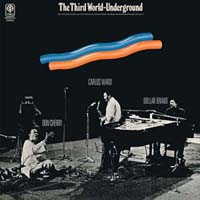
DOLLAR BRAND / DON CHERRY / CARLOS WARD
THIRD WORLD UNDERGROUND (WeWantSounds)
Dollar Brand, the South African-born jazz pianist who died in Summer 2026, was a pioneer. Though rooted in the classical American tradition of Ellington as much as his Township youth (think Father Huddleston's jazz band) he was always looking to push boundaries and collaborate with anyone as interested as he was in such shifting (something a Canadian critic dismissed as National Geographic sounds). An equally boundary-transgressing musician was American-born trumpeter Don Cherry who (after a long stint with Ornette Coleman, Ed Blackwell and Charlie Hayden) traveled the world, almost as a musical nomad, exploring the music of each culture he encountered, from Africa (where he took up ngoni) to India (where he studied Karnatic singing). At one point Cherry decided to put roots down in Sweden (where he married and opened a cultural art center/studio) which is how he ran into Brand (who became Abdullah Ibrahim after embracing Islam in 1968) and Panamanian alto saxophonist Carlos Ward. They jammed one night in November 1972 in a club called Jazzhus Montmartre in Copenhagen, and the tapes were released on vinyl by Trio Records on Japan. That long out of print album has now been reissued by WeWantSounds and presents these great musicians sitting on a peak. Cherry plays krakrebs (not very well) on the song named for him "Cherry," but yelps encouragement to the saxophonist while Brand holds down a rolling vamp on the bottom of the piano. But then he hands the rattles to Ward and rips out a stunning trumpet solo as the tide swells to over 12 minutes of spontaneous brilliance. Next up is a stunning solo rendition of Brand's "Bra Joe from Kilimanjaro." Cherry plucks up the nerve to jump in after 7 minutes to add color to the outtro. "Jabulani-Easter Joy" reminds me of a Western movie theme, though which one I can't quite pin down. Mostly it's Ibrahim's music with Ward and Cherry adding flavor but it is a wonderful live set brought back from the distant past. According to discographies this is the earliest recording of longtime sideman Ward with Ibrahim (they would record over a dozen albums together) and an early encounter with Cherry before Ward joined the band Nu and together they recorded Relativity Suite and Multikulti. Here the triad bounce ideas off the rhythmic underpinning of piano and the relentless left hand of Brand.

ANGINE DE POITRINE
VOL II (self)
It's not often you hear microtonal music in a rock context. You hear it in classical music like Harry Partch or the late Michael Harrison (a devotee of North Indian music who created a 24-note octave piano), but other than Zappa and Beefheart we have to look to arab-influenced bands, or groups like Altin Gün who take the quarter tone scale of Turkish folk music, or dig the entrancing tones of Javanese gamelan music via our cherished Folkways albums. Because here in the West we are stuck with our twelve-tone music (an octave of eight whole tones and five semi tones which somehow add up to 12 because 1 & 8 are synonymous), so to our western ears, anything not resolving into those familiar pitches seems dissonant. I was entranced by this band, whose name means chest palpitations, from the get-go but not initially or wholly because of the music, rather I was sucked into the mythos of their look, superimposed on their sound, which is really what popular music is about: a visual visceral appeal, recognizable from Elvis to Michael Jackson to Shakira. A small online gig four months ago on KEXP, which has now garnered 16 million views, presented this Quebecois duo to the world. They look like characters drawn by Alfred Jarry, and in interviews never deviate from the weird personae of non-earthling beings who have somehow arrived here with a little French and some caricature martian dialect. They are Klek on drums and Khn on guitars; although they are fully costumed it is apparent to me, despite the body paint, they are white. But this doesn't really matter. They are beasts on their instruments. They sample "Train kept a rollin" by the Yardbirds, and there's a famous run from "Pipeline" by Dick Dale. But these are riffs any aspiring rocker has to master, you argue. But that is merely the familiar: it's what's not obviously apparent that is engaging. Check out the scorching asymmetric riffs which are the appeal of this band. Khn plays a double-necked Gibson and starts by laying down a bass riff and, with deft twinkle-toed application of foot pedals, creates a loop, then doubles up on guitar. Once it's percolating, s/he can improvise over their own bass and rhythm set up while brother/partner Khn gets to jam along on some crazy free-form yet very tight drumming. "Mata Zyklek" is the stand-out track but everything they play is intense, and never quite resolves harmonically so you are waiting ("where's that confounded bridge?") in vain. The beauty is in hearing stuff you've never heard anywhere and on top of that comes the joy of watching them perform. Or you can simply listen and get into the sheer head-banging joy of "Sarniezz" which even has vocals as it spirals out of control. You can also get their single "Sherpa" at name your price as a swell bonus track.

EXCAVATED SHELLAC: VOICES (Dust-to-Digital DTD-61)
Jonathan Ward returns with another in his series of elegantly packaged anthologies of rediscovered 78s from his collection. While it is now possible to find archives of century-old music on line, such as the newly launched website playing music from the University of California Santa Barbara archives, it's no use jumping in without context or you quickly get lost, and this is where you need a guide like Ward who spans continents and takes whole eras and musical style in his stride as he curates the gems and situates them in the world for us. There are sixteen tracks here from familiar stops like Madagascar or India, to less-traveled spots like Bahrain and Mauritania. In addition we visit Mexico, Georgia, Mali, Turkey, Portugal, Brasil, Albania, and Morocco. The now-celebrated gravelly Tuvan throat singing style starts us off with "The Chestnut horse with cup-like hooves." You can imagine playing this for friends and having them guess where the songs are from "— Portugal"! (easy) or else just taking it as a flow, like a podcast or a focussed session, like his earlier Reeds & Strings sets. Dust-to-Digital has done major important work on the musical heritage of Africa (Opika Pende: Africa at 78) and the 2CD set of Hugh Tracey field recordings, Listen All Around: The Golden Age of Central and East African Music; they have also taken us to Morocco (Paul Bowles 1959 recordings), but this is not meant be a heavy definitive historical set, just a fun group of tunes to enjoy in the moment. In some ways it's a supplement to Ward's 2021 4-CD set called Excavated Shellac: An Alternate History of the World's Music. So there you have it. A quick tour of the back catalog of Dust-to-Digital will show you all the wonderful once-lost music, not just that recovered by Ward, but you can explore a privately driven project that is as important in its own way as the Smithsonian or Library of Congress collections of field recordings. Outstanding to me on this new disc, are a rocking (& exceedingly scarce) track from Panama of drum and chant music, Lupe Posada from Mexico with classic "weepy" guitar and vocals that Ward calls "drunkenly howling at the moon." The guitar is played by a musician who calls himself a bouquet of chicharón (pork crackling). This 1931 piece was recorded in Los Angeles. From Brasil we hear Mota da Mota with "São Benedito é oro só," a heavy Afro-Brasilian piece also from 1930 or 1931. From Mozambique comes a very South African-sounding piece in a style known as "Shangaan guitar" which eventually developed into marrabenta; apparently Eric Gallo sent singers to London to record and this is crystal clear (I wonder how long the round-trip boatride was!). "Orira," an unaccompanied polyphonic piece from Georgia, with yodeling and handclaps, is also startling and compelling. There are people who collect rare records in order to hog them and brag that they alone have them; others who occasionally let some out into the world but don't seem to know what they have (like R. Crumb), and then great archivists like Ward who are willing to do the work to explain where the music comes from and situate it for us, and labels like Dust-to-Digital giving it voice once again.
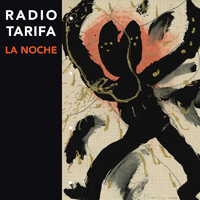
RADIO TARIFA
LA NOCHE (Buda Musique)
Radio Tarifa's fifth album comes after a two decade hiatus. Back in 1985 a trio met in Madrid and had a great idea: imagine a radio drifting between signals in the South of Spain, picking up Andalusian and Arabic music. Two of the trio were into performing medieval Spanish music which already had that fusion in its bones; the arrival of Benjamin Escoriza from Granada brought it into the 20th century with rock guitars and studio effects. They were nominated for a Latin grammy for Fiebre and toured the world to great acclaim. Benjamin's poetry brought it to life vividly, but sadly he died 20 years ago and the group disbanded. Now they have reformed and even have an unfinished piece by Escoriza to kick it off beautifully, making a continuity to their earlier sound. It's folkloric and medieval with major flamenco and arab flute elements, just like the earlier discs. I'm not big on medieval music but "Quel sol che raggia" reminded me of the Coventry carol "Lullay lullay." I guess it's the flatted harmonies. Faín Dueñas is the leader, playing guitar, bass, percussion, organ, guimbri, handclaps and even koto. Vincent Molino adds the woodwinds: ney, arghoul, bawu, cromorne, oboe and keyboards. Guests bring violins, accordion, cello, bass. I think I hear harp on "Sakura," a Japanese folk song, though it's not credited, so maybe that's Dueñas on the koto, playing with his thumbs instead of plectrums* (*I know the plural is plectra, but since we say stadiums and not stadia, I will assume it's Anglicized). Escoriza had one of those great deadpan flamenco voices and they capture that again, especially with the guest vocalist Jose González on "Sabah" and Javier Castrillón on "Soleà del desamor," which also features a really plankety banjo. Welcome back!
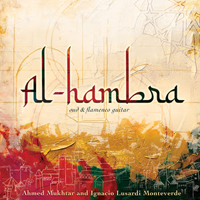
AHMED MUKHTAR & IGNACIO LUSARDI MONTEVERDE
AL-HAMBRA: A Musical Dialogue Between Oud and Flamenco Guitar (ARC Music EUCD2972)
Ahmed Mukhtar from Baghdad on oud and Argentinian Ignacio Lusardi Monteverde on flamenco guitar make a logical connection between the related musical traditions of their two cultures. Mukhtar founded the Taqasim Music School, whereas Monteverde won the Latin musician of the year award in the UK. The compositions spark back and forth between the two, in an intricate and subtle exchange. Mukhtar is the author of Arabic Music and the Oud and the Mukhtar Method series, for learning the oud, darbuka and Arabic music theory. His partnership with Monteverde began in London in 2017. This album reflects their shared vision. Mukhtar says, "Since some oud techniques were challenging on the guitar and vice versa, I carefully composed with both instruments in mind. Even in my taqasim (improvised sections), which are deeply rooted in the Arab oud tradition, I aimed to draw the guitar into this musical language." They have performed together in Bahrain, India and Iraq, building a strong musical bond. With Al-hambra they bridge time and traditions fluidly. The oud came first of course but the Spanish guitar of Andalusia took the music into another realm. They share melodic structures such as maqãm and scales of flamenco, drawing on a range of influences, from Latin America and classical Arabic modes. "Baghdadi girl," "Iraqi Merengue," the ballad "Quietness" and "A Moment of Taqasim" stand out, but the surprise is the appearance of Rimsky-Korsakov’s "Young Prince and the Young Princess" which is a brilliant choice to close and showcase the "oriental" aspect of a lot of Western music. The title track, "Al-hambra," pays tribute to the masterpiece of architecture that shows the foundational solidity of Islamic culture in the Iberian peninsula.

EDNA MARTINEZ PRESENTS PICO!
SOUND SYSTEM CULTURE FROM THE COLOMBIAN CARIBBEAN (Strut 218CD)
In sixteen well-chosen tracks full of surprises, Edna Martinez shows us what a great DJ is capable of: she welcomes us with some folkloric singing and drumming and then takes us on a whirlwind ride through the music that enchants those tropical dancefloor grinders who straddle America, having one foot in the Atlantic and the other in the Pacific. Her stopping off places — Kenya, Congo, Nigeria — are familiar, as are the artists even: from Peacocks International Highlife Band to Zaiko Langa Langa, but she mixes it up brilliantly and periodically comes home to ground it with a well-placed cumbia or the champeta number "Puxa Odette" by Conjunto Ana N'gola. Since their name suggests they are Angolan, there is some deft tricksterism in her choices. The liner notes explain that champeta is a blend of mbaqanga, bubble gum and jive from South Africa, soukous from Congo, zouk from Martinique and soca. You know what Picós are: sound systems that blare out all over Latin America, and are particularly well-known in Jamaica and Mexico, but are concentrated, it would seem, in port cities like Cartagena and Barranquilla. Since their first establishment in the 1940s, the secret weapon of the picós has been exclusive tracks: discs bought from sailors or passed between traders and collectors. When a particularly tasty rarity comes along, with a great seben or instrumental, the DJs extend it by nimble needle-drops: deftly returning to the start of the bridge or break to keep the dancers moving and grooving. The effect can be mesmerizing. Here the secrets are revealed: from a 1960 LP Como Sea by Claudio y su Combo (a clean copy was found thanks to the Gladys Palmera archive!) to the 1980s, this is fabulous music. The most recent cut is by Zaire (who are from South Africa), called "I'm Tired of Living in the Shack" which is very poppy. In addition to the Peacocks we hear another Nigerian act, African System International, with "Amina" which actually sounds like soukous; from São Tome the great Pedro Lima rips out "Philomene" which was released in Brazzaville in 1981. More tricksterish sleight-of-hand. Claudio y su Combo are the sole Cuban entry and give us a timbales solo as good as "Ran kan kan." Martinez stretches to Algeria to find Afous performing "Anaxdhou," which she has turned into an extended mix, though it is still only 4 minutes long. Yes, it is a fast tour! The Zaiko track is a killer, "La tout neige," with the bell-like tones of Manuaku-Waku on guitar pealing out. And in true DJ fashion, she slips in a rootsy drum-and-chant piece next to keep us guessing: it's Eric Cosaque with a gwo-ka number from Guadeloupe. Martinez has added reverb and a loop to this, I think. Legendary Puerto Rican singer La Calandria is up next with a great but very obscure track, "Come duele una traicion" which was on a 1961 US-issued Ansonia LP with the undistinguished title Con Guitarras volume 2 (There is a copy on discogs for $75). The album ends with another brilliant track, "Dada Asha" by Tabora Jazz Band, a group that deserves induction to the Zanzibara series of classic Tanzanian reissues. At the risk of overusing the superlatives, this is a fantastic compilation.

OZAN BAYSAL
TEL VE TEN (Naxos/ARC Music EUCD2976)
There may be a chicken and egg story here. I put on the debut album by Ozan Baysal and my first thought was, he has been studying Hans Reichel (1949-2011), the innovative German artist, graphic designer and guitarist who created a unique sound by redesigning his instrument to be basically two conjoined guitar necks. He played by damping on both fretboards simultaneously, in a style known as hammering on, letting the amplification reveal the sonic subtleties. Now, listening to this, I also learn that it is a traditional Anatolian style of playing with various sub-techniques (plucking, hammering and strumming), collectively known as şelpe. So maybe Reichel heard it in Turkey. Baysal also has a double-necked instrument, called a baglama, or sometimes a saz. He is a scholar, and is also reputed as a jazz musician (Anatolia is Eastern Turkey, or Western Asia, depending on where you are standing). Baysal brings virtuosity and great creativity to improvisations on traditional themes with this instrument. The title translates as "String and Skin" and he is joined, briefly, by bendir (on "Cakal Cokerten Zeybegi"), acoustic bass, electric guitar (on "Childhood Memories") and vocals (on "Beyond Dreams"). Having attained a Ph.D. in şelpe music studies from Istanbul University, Baysal is pursuing post-doctoral research in London, where he has found an expatriate community who still keep şelpe traditions alive. The music is complex and exciting; the modal forms of the old tunes have been augmented with Western harmonies which adds richness and depth to them.

DANILO PEREZ & BOHUSLAN BIG BAND
LUMEN (Prophone Records/Naxos, Sweden)
I first noticed Panamanian pianist Danilo Pérez in 1996 where he put out an album of Monk covers, called Panamonk. As a fan of Latin bands covering Monk's music I jumped on it and got a lot out of it. Since leaving Berklee College of Music as a student Pérez has returned as their artistic director of Global Jazz. He has continued to tour, perform and record, and his latest venture features a Swedish big band. Like the Maroon Commandos in Kenya, the Bohuslän Big Band were originally a military unit who continued to perform after they returned to civilian life. They make a good fit with the gentle lyrical playing of Perez and the arrangements are lush and sweet. The wall of brass swells but never overwhelms the piano and the drums and percussion keep everything tight and together. The soprano sax and flugelhorn soloists also improvise in counterpoint to the piano, fitting right into the mix which includes influences from Latin-American folk music, as well as West African and Middle Eastern sounds. The project began when Pérez was invited to be artist in residence at Vara concert hall in Sweden (north of Gothenburg, it is equidistant from Stockholm, Oslo and Copenhagen). His background is with Dizzy Gillespie's United Nations Orchestra and Wayne Shorter's quartet so he is at home with horn players as well as arranging for a larger band. The big band comprises two altos, two tenors and a baritone, all of of whom double on other woodwinds, four trumpeters who also play flugelhorn, four trombonists, bass, percussion and drums. We shouldn't be surprised when the congas and percussion fully engage in a Latin groove: from the outset they are swinging.

BALLAKE SISSOKO & DEREK GRIPPER (Matsuli Music MM127)
We have become used to hearing kora mixed with other instruments, such as cello or rock guitar, but here the juxtaposition is with classical guitar which seems more appropriate as, in a sense, the kora is the classical guitar of the Manding culture. Ballaké Sissoko has had a long career, starting out in the National Instrumental Ensemble of Mali. He has also recorded with Italian pianist Ludovico Einaudi and French cellist Vincent Segal. In 2012 Derek Gripper recorded One Night on Earth where he boldly adapted the music of the 21-string kora to his 6-string guitar. For that set he included a composition by Ballaké Sissoko, so it was inevitable the two would meet and find common ground for musical dialogue. Their encounter took place in London with a series of concerts where they each brought tunes but also jammed and bounced off one another's improvisations. Then they took it into the studio while the heat was on and the traditional music of the jalis was pushed in new directions by the duo. "Koortjie" (a Gripper composition) even has a hint of machine music at the start: I am talking about a built-up drone you might hear in Philip Glass or Frederic Rzewski. So it veers towards modern classical music, sidestepping neat categories like "World beat," or "Jazz fusion." Their jam, "Daraka," is the first single off the album and it is haunting and atmospheric, not to say aethereal. Sissoko vamps while Gripper attacks the spaces in the chords with tattoo needle-like intensity, then they switch roles and set up a tidal wash that moves back and forth before fading out, too soon. The shorter tracks are highly polished. The album closes with Gripper's composition, "Basle," and, as I associate the Swiss with clocks, it has a chiming precision, it seems to me, with once again a metronomic and mesmerizing sway between the assembled 27 strings.

KOLONEL DJAFAAR
GETAWAY (Batov Records)
It's been 3 years since Kolonel Djafaar released their sensational EP Cold Heat, and so I was primed for their new album Getaway. They are an evolving group of Belgians who play jazz with an Afrobeat drummer and some 70s touches, including Farfisa organ and guitar with simple effects like reverb and echo. There is also what I would call primitive synth, i.e. basic twiddling on a Moog. The new album has hints of psychedelia and Ethiopica (?), both converging on "I call her Winnie," but it also reminds me of soundtracks by the likes of Bernard Hermann and Ennio Morricone. I checked the credits for "The Getaway" with Steve McQueen and Ali MacGraw (1972): the soundtrack was by Quincy Jones, but I don't remember it. I just remember the leads in their stylish designer togs getting crushed in a trash compactor without losing their cool. Nevertheless there is a theatrical ominousness to tracks like "Convoi Exceptionnel" which soars into a funky crescendo. The brass (tenor, baritone and trumpet) have definite soul chops, and lead the line on simple ditties like "Kelmendi" which echoes Jamaican jazz, like Ernie Ranglin or Monty Alexander, both of whom would fit in seamlessly with the groove. There are many catchy hooks on here: "Siren's Glitch" has an Arabian sinuousness to the melody. Maybe Djafaar is a reference to the wily vizier in the 1001 Arabian Nights? "Phil's First Tear" kicks off like a Memphis soul jam, then the Ethio horns charge in. The drummer keeps it in the pocket. This is the core of the album, before we slide back into a more mellow downtempo groove, which is really perfect for on-the-nod listening. "Apologies in Advance" ramps up the percussion but slides into overload on the Echoplex, as if they ran out of ideas. They should have ended it sooner, much sooner. The last cut is devoted to Lodewijk Lefevre on the baritone sax which is a very good way to go out.

GAO HONG & IGNACIO LUSARDI MONTEVERDE
ALONDRA (ARC Music)
Last time we met Gao Hong, a year ago, she was jamming with a kora player, Kadialy Kouyate. That album won awards and made me notice Chinese pipa playing for the first time. Now the pipa player has teamed up with Ignacio Lusardi Monteverde, a flamenco guitarist, and turns in an equally impressive set. This is Gao's first encounter with this particular style of guitar playing. The title means "Skylark" and suggests the creative inspiration found in nature, such as bird calls. The challenge the two musicians faced, in blending very different styles of music, was met in the celebrated Abbey Road studios in London where they got to know one another in a lively musical conversation. Not all jamming is worth preserving, but here the two are cautious and respectful as they feel out the spaces in the music. Gao's response to the flamenco flourishes are poetic which leads in turn to Monteverde pulling out all his best licks. Birds are an apt image as the music does swoop and soar. In another ornithological reference they do a cover song: "La Paloma," a famous Spanish song from 1860 inspired by a trip to Cuba. It's a Habanera but has that distinctive stretched cadence familiar from Tango and the work of composers like Albéniz.