THE LAST POETS
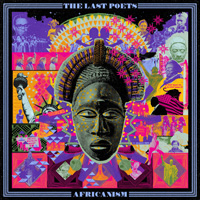
AFRICANISM (Africa Seven)
Poetry with music has been around since ancient Greece, but nowadays we automatically think of hip hop — which really came out of Jamaican Dancehall — as the beginnings of a new style of music in the 70 where performers rapped their lyrics over a backing beat. Around 1968 the Last Poets were formed in East Harlem and recited their lyrics to a backing of congas; their first gig was a celebration of Malcolm X's birthday. Their goal was to raise black consciousness through political awareness and an uncompromising message delivered to fellow oppressed blacks. In the 90s they had a comeback: I think I saw them at the Kennel Club. I may be wrong, because at the time I was seeing three or more shows a week (one of the perks of working in radio was putting myself on guest lists) and so did I go down there to the Fillmore on a grey night and hear the immortal lines "Wake up Niggers or we're all through!@"? Perhaps. And I assumed when the great Gil Scott-Heron died that he was the last of that first wave of hip New York jazz poets, though Scott-Heron was also a musician leaning heavily into soul. However, the two remaining Last Poets, Abiodun Oyewole and Umar Bin Hassan, have been writing and performing again since 2018. But the congas of yore had been ousted by turntablists and samplers so the duo needed something a bit more electrifying to give them a groove to rap over. Enter the late Tony Allen, master drummer from Nigeria who drove the music of Fela Kuti. After Fela's death he was in demand as a session man and had in fact laid down tracks in 2019 in Brighton, UK, for this album, but the pandemic caused it to be shelved. After the air was cleared the project went ahead. Abiodum selected four pieces from the group's debut album in 1970, including "When the Revolution Comes," which famously was answered by Scott-Heron with "The Revolution will Not be Televised," originally backed by only congas and bongos. This album is worth paying attention to, though so far I have not figured out all the lyrics. Elvin Jones once said, "I like rap music because it pisses off Whitey." And while I am not eager to be pissed off, I ignore most of it because all I hear is what someone described as "Nigga noise"— just a stream of abuse with the infamous "N word" repeated twice per sentence, and in this instance some really sticky probably sexist poesy about blow jobs. But again you need to listen to this because of the music. Yes, the music is really engaging. In addition to Tony Allen's famous driving beat we hear some very sweet guitar and bass lines courtesy of Egypt 80, so it's truly an update on Fela's Afrobeat. But there's more: instead of the bogus sax playing of Fela we have Courtney Pine who knows how to finger the keys, and Kaidi Tathsam on keyboards, who also is an upgrade from the Nigerian progenitor of the sound. Despite having some old poems the trade-up is the improved sonic landscape of the band and a fitting framework for a legendary rap group.
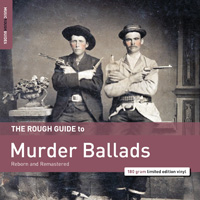
ROUGH GUIDE TO MURDER BALLADS (World Music Network RGNET1426DD)
We leave the Blues to enter the world of folk music with this new Rough Guide. With an emphasis on the lyrics we have accompaniment from banjos, guitars, mandolins and violins. The singing brakeman Jimmie Rodgers who wowed audiences in Africa with his yodeling, delivers the classic "Frankie and Johnny." We know Frankie was cheating with Nellie Bly, but is it the same woman who followed Jules Verne's itinerary around the world in 80 days and wrote an exposé of the condition of women in mental institutions? "This story has no moral," Jimmie assures us. "There ain't no good in men." You also know Stack O'Lee, but probably have not heard Furry Lewis' version. In fact a lot of these lyrics are very familiar as they passed from folklore to everyday currency: "Hang down your head Tom Dooley, hang your head and cry, hang your head Tom Dooley, you know you're going to die." There are the sordid details, that he hid Laura Foster's clothes before raping and murdering her on a hill. Somehow it's a very cheery rendition. There are no liner notes, but I can tell you, as a student of print culture, that dying men's confessions and ballads about high crimes were popular back in the 17th century when street hawkers, know as chapmen, would sing them in the streets to generate sales. Some sold thousands of copies. Though they had no music, they were forerunners of sheet music, as most had metrical scansion that would fit many tunes. The galloping urgency of the banjo adds momentum to epics like the ballad of Old John Hardy, who got away with murder, performed by Clarence Ashley. The great Mississippi John Hurt delivers a sweet ballad about Louis Collins who lost a gunfight: "Angels laid him away / They laid him six feet under the clay." The epic "Railroad Bill" may be about a black train robber who threw goods off moving trains then went back to recover it, before being shot. It includes the famous verse, "If the river was whisky and I was a diving duck, I'd swim to the bottom and never come up." I remember the Savoy Brown version: "I'd swim to the bottom, and drink myself back up!" In "Murder in the first degree," Victoria Spivey, one of the first black female stars, admits to killing her man, but "the world's rid of one triflin' man"! If the tables were turned, she tells the judge, I'd let you go free. The album ends with "White House Blues" about the assassination of President William McKinley and arrival of Roosevelt as president. Recorded in 1926, it's a heavy reflection on political violence which is always boiling under the surface and the fragility of those in power, still relevant a century later.
NATION BEAT
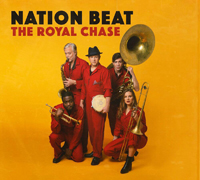
THE ROYAL CHASE (nationbeat)
I am keen on all kinds of brass band music, from high school marching bands to Lester Bowie's Brass Fantasy, from Neapolitan funeral bands to Indian wedding bands, English colliery bands to Mexican banda. As long as it has good arrangements and is swinging, I am all ears. The Nation Beat is the project of drummer Scott Kettner who decided to fuse New Orleans style brass with the music of Brazil and came up with funky forró. The transposition of accordéon to brass works just fine. I recently read a fascinating history of New Orleans by music scholar Ned Sublette. He cuts off the narrative around 1860 so it is long before recorded music but he does include some excellent information on Louis Moreau Gottschalk, the father of American jazz, and his Caribbean roots, and he furnishes a real sense of the trans-national flow of music from Africa through the Caribbean to the unique town that was actually under three different flags in its early history-- Spain, France, England-- before becoming American during the Louisiana purchase. For this new album, Kettner brought along tenor saxophonist Paul Carlon who has worked with Tony Allen and who turns in a great haunting "Big chief." Carlon has also ventured into this type of music before with "Morô Omim Má" on his own album, Roots Propaganda, which is reprised here in a different arrangement. The other players are uncredited on my promo copy but on the video they are identified as Joe Correia, sousaphone, Mariel Bildsten, trombone, and Mark Collins, trumpet. Organ creeps in too. There are also guest vocalists, to sing "Algunas cantan," and the Norlins chestnut "Hey pocky way." They tear into Luis Gonzaga's "Forró no Escuro" and there's a lively rendering of Clara Nunes' hit "Feira de Mangaio," though with the accordéon and triangle parts transposed, again, to brass and percussion. They end with another Sivuca composition "Roseira do Norte." It's short but sweet.
LOS MOCOSOS
ALL GROWN UP (OneRPM)
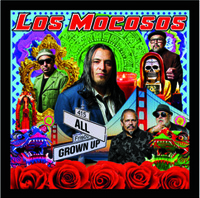
San Francisco Bay Area group Los Mocosos have reunited after a 15 year hiatus and created a great grooving Rock-en-Español album recapturing Low-Rider glory days. One of many Mission District garage bands formed in the wake of Santana, Malo and many others, they covered the evergreen "Volver volver" as well as Herb Alpert's "Lonely Bull," so there's a Latin beat to their sound but its more funk-rock than salsa, more Sly Stone than Tito Puente. Their first single off the new album "United we stand" exudes a great soul sound reminiscent of Curtis Mayfield. Their lyrics have moved toward rap rather than singing, but the sound is still classic with Farfisa organ, pumping horns, rock guitar and bongos. In the decades since they last played together, individual members joined Latin Soul Syndicate and the Hip Spanic Allstars, but mainly were writing music for TV shows like The Sopranos and Desperate Housewives. Also Mexican-American music evolved with the likes of Ozomatli and Café Tacuba finding new directions. The key players Happy Sanchez (bass), Victor Castro (trombone) and Shorty Ramos (sax) worked with different vocalists to find the right sound. They brought in Santana percussionist Karl Perazzo, and the overall production values are really tops. Twenty-two years ago they were the snot-nosed brats, now they are all grown up.
JOHN COLTRANE QUARTET
BLUE WORLD (Impulse)
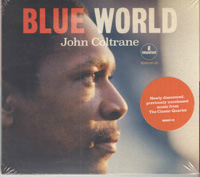
On the rare occasions when we went to the cinema in my childhood (at a town 4 miles away), we just showed up, bought tickets and went in. Sometimes they were showing a newsreel or the cartoon was on, or the feature might have already started, but it didn't matter. You sat through the show and then when it got back to the part you recognized you said, This is where we came in, got up and left. As jazz historians unearth rare discoveries of lost tapes by the past masters, Miles, Monk, Stan Getz, Trane and so on I kept up with it, until I felt it was getting a bit silly and decided this was where I came in and had heard the rest. For example, Craft recently reissued the 1958 Prestige sessions of Coltrane's works, essentially duplicating parts of Side Steps and Fearless Leader, and now Impulse have found another lost Trane session with the classic quartet. I looked at it and thought, hmmm, I have all this, and if it's anything like the Monk "Liaisons Dangereuses" soundtrack not particularly thrilling, even for a completist. "Liaisons Dangereuses" was marketed as a discovery of a lost soundtrack -- French and from the same period as the astounding Elevator to the Scaffold of Miles, even featuring the French tenor player Barney Wilen who had accompanied Miles. But in fact it was Monk doing what he does: playing his set, which has been documented on many live albums. So I decided to hold off on Blue World, making another mistake. First, mid-60s Coltrane was rippingly good (he had given up exploring the avant garde with Dolphy after Down Beat called it "Anti-jazz," and was retrenching by exploring ballads), and even though there are live concerts from this period (the magnificent Live at Birdland), there are only two studio recordings that year, including A Love Supreme where his spiritual concerns begin to manifest. What is going on here with Blue World is a serious request from a Canadian filmmaker for Trane to play a setlist of a few of his classics from Atlantic 1959-60 to be used in a film (which was in French so got limited notice outside the Francophile world). Unlike Monk, Trane did not revisit his old repertoire much. The hauntingly lovely "Naima" did feature at the Village Vanguard in 1961 and on the European tours of the next couple of years. Of the other material here, only "Traneing in" showed up on a date in Europe 1962. For once I am happy to listen to some fresh takes of his back catalogue over and over again. It's a crystal clear recording and the set, all Coltrane compositions, is very coherent.

HIP SPANIC ALL STARS
OLD SCHOOL REVOLUTION (Hip Spanic Records)
Before gentrification San Francisco's Mission District was a happening scene. It was gritty (still is in places) and visceral with low-rider cars cruising and blasting their stereos, spontaneous conga jams in the park, little clubs like Bruno's, El Rio and Elbo Room, and big ones like Cesar's Latin Palace. Places for poetry, improv and comedy, like Intersection, Artists Television Access, the Marsh and other indie scenes thrived there. Churches were packed on Sundays; there were bakeries, bookstores and of course scores of taco stands. I lived there in the 1990s and worked part-time at Round World Music. The neighborhood started becoming "the new Bohemia" as people gave up on North Beach and the Haight-Ashbury trying to avoid tourists and looking for cheaper places to live. The "sound of the Mission" had been defined in the 60s by Santana and in the 70s by Tower of Power, Sly & the Family Stone and other funk bands. It's a sticky sweet mix of pop, soul and Latin grooves and is captured perfectly by the Hip Spanic Allstars on their new disc Old School Revolution. The group was formed by ex-members of Los Mocosos who found former members of Santana (timbalero Karl Perazzo), the snaky guitar of Spearhead, and indeed Tower of Power (trombonist and baritone saxophonist) with time on their hands and an urge to groove. Some band members formerly known as Latin Soul Syndicate did a lot of soundtrack work for The Sopranos, Devil wears Prada and John Leguizamo's last film. The old school of the title is the Chicano groove and surprisingly they kick off with a non-Latin pop song "Crystal Blue Persuasion" which was a 1969 hit for Tommy James & the Shondells. The original did have bongos and big horns and of course an irresistible Hammond organ groove and it's great to hear it recontextualized as a low-rider classic with layers of percussion. There are also audible echoes of the Rascals and Mazacote. The album is poppy but has consummate musicianship especially in the tropical sounds of "Bacuna Wow Wow Wow" and their cover of Sonora Santanera's "La Boa." A bit late for the summer party under the stars, this is still a guaranteed crowd pleaser.
ALLEN TOUSSAINT
THE BRIGHT MISSISSIPPI (Nonesuch)
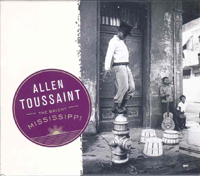
November 2015 saw the passing of Allen Toussaint, one of the giants of New Orleans music. He was a producer (Dr John's In the Right Place is one example), arranger and performer, but best-known as writer of an incredible string of Soul & R&B hits for Irma Thomas ("Ruler of my heart," "It's Raining," "Time is on my side"), Lee Dorsey ("Working in the coal mine," "Ride your pony," "Holy cow," "Ya ya," "Get out my life, woman," "Everything I do gohn be funky," and many more). He knew how to write a hit, in fact he once said, "Other people get up and build cabinets, I write songs." He was also skilled at taking a song someone had brought into the studio and improving it. The first wave of British rock bands in the mid-60s covered his tunes such as "Fortune Teller" and "Time is on my side" and made them hits for the white pop audience. Toussaint continued working behind the scenes in New Orleans as a producer and arranger, even filling in for Fats Domino on piano on one of Fats' hits! After Hurricane Katrina destroyed his home in 2005 he moved to New York and began to play solo piano at Joe's pub in Greenwich Village. The response was overwhelming and he was soon back out on the road enjoying the fruits of his long career in an endless world tour. In fact he had just played a concert in Madrid when he died of heart failure, aged 77. He wrote hits for Aaron Neville, Ernie K. Doe and Otis Redding in the 60s. (As a joke on the Neville Brothers he sometimes used the pen-name Naomi Neville, thereby becoming the elusive Neville "sister.") His house band, the Meters, also benefitted from his compositional skill. Glen Campbell's cover of his "Southern Nights" went to number one on the pop charts; remakes by Boz Scaggs ("What do you want the girl to do?") or the Pointer Sisters ("Yes we can can") regularly gripped the national musical consciousness. As a skilled pianist in the lineage of Professor Longhair, Toussaint had deft fingers on the keys; I enjoy his playing immensely. To Fess' Bach he was often called the Amadeus of New Orleans. Bright Mississippi is a studio recording from 2009 with an all-star lineup of jazz sidemen, including Don Byron and Nicholas Payton. There's a few familiar tunes on here, not to say chestnuts (he himself penned "Java," a hit for Al Hirt, and now part of New Orleans street lore), but the calibre of musicianship makes Bright Mississippi a treat. The emphasis is on the New Orleans repertoire, so we start with Sidney Bechet's "Egyptian Fantasy" and also hear from Jelly Roll Morton and Joe "King" Oliver. Nicholas Payton features on trumpet and does Pops justice on "Dear Old Southland" a tune made famous by Armstrong. Toussaint doesn't step to the fore until "St James Infirmary" which he renders sparely with a range of stylistic effects: Victorian parlor trills alternate with curt, choppy single digit picking. This sets up a prickly acoustic guitar solo from Marc Ribot. Speaking of acoustics, the set-up for "Singin the blues" has the drummer (Jay Bellerose) sounding like he is way at the back of an empty bar with the piano and trumpet up close and cosy with the mike. I am sure Toussaint suggested this to the engineer. As a sign of his lack of ego he invited another pianist Brad Mehldau to sit in on a duet on Jelly Roll Morton's "Winin' Boy Blues." They are in separate stereo channels, you have to guess which is which. King Oliver's "West End Blues" must be one of the first version of a "Slow Drag" to be recorded: a smoky blues with raggedy-ass drumming, tight sophisticated piano runs and little expletive outbursts from the horns. Ribot is back, snapping at his nylon strings. The sextet returns for a sexed-up finale and quits too soon (maybe thinking of the constraints of a 78 rpm). Ribot gets the spotlight on a Django tune, followed by a chance for Byron to shine on the old hymn "Just a closer walk with thee," one of the most popular tunes at New Orleans funerals -- its origin is believed to be a pre-Civil war African-American spiritual. I hear where Randy Newman is coming from in the piano part. Now to to the title tune, which I have been eagerly anticipating, being a huge Monk fan. "Bright Mississippi" (Monk's deconstruction of "Sweet Georgia Brown") already has a slight shuffle to its step, perfect for Second-line intervention. Here's Monk's tune as a New Orleans stomp with bompy kick drum and wonky keyboards. There's a bit of Huey Piano Smith, a bit of Vince Guaraldi, some Monty Alexander, anyone but Monk as suddenly the acoustic bass (David Piltch) and drums go into what could loosely be called "dub"! It's too short but leaves us time for two Duke Ellington tunes and one more. "Day Dream" brings in Joshua Redman, another stellar member of the younger generation of jazz artists (& an alumnus of Berkeley High Jazz band), on tenor sax. This perfect musical excursion ends with "Solitude" in a sparkling duet with Ribot. Without showing off, Toussaint gives us a little lecture on New Orleans piano styles (he had absorbed Albert Ammons, Pinetop Smith and a host of others), but then modestly returns to comping and steps back to frame the acoustic guitar. I played this album for the Duchess and she commented, It's like a happy funeral march. Indeed it is.
NEIL DIXON SMITH
THE PANAMERICANIST (self-produced)
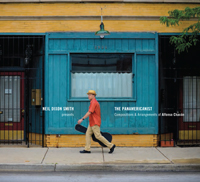
Neil Dixon Smith is a guitarist who is devoted to the music of Alfonso Chacón (1934-2011), a Chilean composer and performer. He has put together a website and an album called The Panamericanist, that features his playing on some classic songs from the South American repertoire. Chacón left his native Chile in the 1960s and travelled around South America learning regional guitar styles and adapting folk songs to the guitar. He spent years in Argentina and Venezuela before arriving in Chicago in the 1990s where Smith took a class from him. Smith describes their first encounter: "he delivered an expansive sampler course of Latin folkloric styles and then a more general demonstration of the sonic and expressive possibilities of a lone nylon-stringed guitar. I was awestruck. I had never seen or heard anyone play guitar like that before. Solo guitar music, a mix of straight classical and crazy unbeknownst folkloric techniques. Intense stabbing and digging at the strings segueing to gentle romantic lines to dancingly dense rhythmic strums that immediately combed my hair in new ways. Call it soul music, it felt equally fresh and vibrant as rooted and old. And it looked fun as hell to play, if not impossible." Smith decided to apprentice to the master to preserve his vast knowledge. The Panamericanist is a great three-quarters of an hour of solo acoustic guitar. It kicks off with four tracks by Chacón, then takes us on a tour of other South American composers, Enrique Yépez's "Pasional," Carlos Ortiz's "Flores Negras," are both from Ecuador. There's a bambuco from Colombia: "Antioqueñita" by Pelón Santamarta; three tracks from Argentina (two of them are tangos, but it's the milonga, "Los Ejes de mi Carreta," that I found particularly moving), and he ends with two waltzes from Peru. I am not familiar with any of this music, knowing only a few pieces in the Brazilian guitar repertoire, but of course the Spanish influence is evident. Smith's playing is superb: while his scholarship is apparent, it's his passion in performance that is impressive. Well worth delving into.
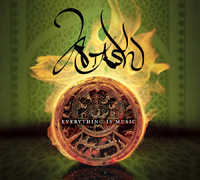
ATASH
EVERYTHING IS MUSIC (Self-published)
Here's a band that takes the potpourri approach to the music of the world, combining as they do members from India, Africa and the Americas. Based in Austin, Texas which is known for country, folk and Latin music, Atash feels more at home with flamenco, reggae, jazz, rock and Indian classical music. Their name comes from the Persian word for "Fire" and refers to Zoroastrianism, the pre-Islamic religion of sun-worshippers. Another classical reference is in the album's title which comes from Rumi, the 13th-century Sufi poet. Just as fire is one aspect of the life force, music is the essence of our being. Individuals bring musical ideas to the group then everyone throws in what they want -- the result is a blend of all their backgrounds. I thought I would be turned off by this but the blend of oud and sitar works, and the rhythms, whether Middle Eastern, African, or Other, are all well-suited to the tune at hand. The singer, Mohammad Firoozi, grew up in rural Iran. He led the call to prayer at the village mosque but secretly listened to Western rock 'n' roll broadcast from Kuwait on his dad's radio. He would sing in pidgin English in clubs in Shiraz to crowds who didn't understand him, and now, decades later, he sings in Farsi in Texas, again to an uncomprehending audience! His "Amshab" reminds me of ONB, it has a wonderful dubby bass 'n' drums and then the oud and strings (on Echoplex) take us back to the Grand Bazaar. I like this because it sounds authentic, it's not a bunch of posers playing afrobeat, but people from divergent cultures coming together and sharing their joy of music. They worked on the album for over three years, writing new pieces and revising old ones. You can tell a lot of thought and effort went into it. The qawwali number, "Baaraan," is a stand-out with tablas and handclaps, then bandleader Roberto Riggio comes in on mournful violin behind Firoozi working out on the vocals.
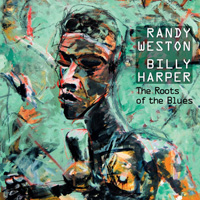
RANDY WESTON & BILLY HARPER
THE ROOTS OF BLUES (Sunnyside SSC3097)
Jazz is normally outside the purview of muzikifan. Not that I do not listen to it, in fact it's in heavy rotation, but because it is widely covered in other media and this site is dedicated to music of other "worlds." However when you consider that Abdullah Ibrahim is African, by birth, and that Pharoah Sanders (among many others) has played with African artists, you have to allow for genre-creep or some crossover in my column. Randy Weston is an American musician, however he was so enthralled with African music that he moved to North Africa 40 years ago and has produced several important suites of music incorporating African rhythms or instruments, including Volcano Blues, Marrakech in the Cool of the Evening, and The Spirits of Our Ancestors. While keeping a recognizable American feeling in his own playing (shades of Monk, Ellington, and a monster lefthand that really strides up and down to grasp big clusters of notes), Weston has also had a long and profitable partnership with American saxophonist Billy Harper. I saw them in concert six years ago and finally this year they recorded an album of three standards and ten of Weston's own tunes. Harper on tenor has a warmer and more mellow tone on this session than you'd expect from hearing his other work. Seems like he jumped on the Coltrane and even communes with the cetaceans on "The Healers," the longest cut here. Interspersed among the gems of Westoniana are "Body and Soul," "How High the Moon," and "Take the A Train," each of which points to a moment in Weston's own musical development. Clearly these guys are having a lot of fun in the studio, but they are working hard too. Harper and Weston first met in Tangier when Weston organized a jazz festival and invited the Max Roach group. Oddly Roach didn't make the trip and Weston ended up playing drums (!) behind Harper and the other members of the quartet. For The Roots of the Blues they decided to explore the darker tones of their instruments. Weston got hold of a Bosendorfer with extra low notes! "Blues to Africa" is based on the way elephants walk, he insists. Lagos and Dakar are also stops on the musical itinerary with "Carnival" which Weston wrote after visiting Bobby Benson's Caban Bamboo club in Lagos (and first recorded with Harper in 1974) and "Blues to Senegal," composed after hearing master percussionist Doudou Ndiaye Rose. One of my favorites is the atonal "Congolese Children's Song" which Weston wrote in 1963. Strangely enough he was gigging in the Berkshires and had plenty of time to listen to music, so was digging folkloric African albums which inspired this piece. How time flies, and it's hard to believe Weston is 87. This latest musical statement is an encapsulation and summation of many of his themes, a digest of his travels and a tour of his wonderfully diverse career.

URI SHARLIN AND THE DOGCAT ENSEMBLE
BACK TO THE WOODS (Folk Dune/Naxos)
Hey this is alright. Even a touch HansReichelish in places! I looked at the lineup and thought it looked like maybe gypsy jazz. Then I looked on Youtube and saw some noodly stuff so the CD sat in its shrinkwrap looking sulkily at me for a month every time I turned over the inbox looking hopefully for something that wasn't there. Sharlin plays accordion and something called "wurli" (which is a Wurlitzer organ, souvenir of a Natalie Merchant tour, which appears on the most straight-ahead jazz track "Don Quixote."). DogCat includes bassoon and bass clarinet, my favorite woodwinds, on three cuts, as well as a bassist, a brace of percussionists and an electric guitar. Guests include Ze Mauricio on pandeiro. It's all original, very original material, apart from a Hermeto Pascoal cover, "Dia #342," which is appropriately out. Sharlin is from Tel Aviv and grew up hearing Russian songs translated into Hebrew and Arabic music. He was going to move to New York to study jazz piano but ended up playing keyboards in a cumbia band. That was when he got the idea of switching to accordion from all the vallenato he was hearing. On "The Real DogCat" we gather that they are secretly Rastafarians, since this is a reggae number with the woodwinds playing lead and an added zabumba (a big Brazilian drum you wear round your neck). Sharlin says he was inspired by Caetano Veloso's Livro to add the woodwinds. It was a smart move: it creates a lovely warm sound, as opposed to gypsyish accordion with jazz guitar, which can be pretty pedestrian. The feeling of Brasil is palpable in the warm ballads "Mundau by Day" and "Mundau by Night," and the closer "Baiao," a lively forro track, on which a flute duels with the bassoon.
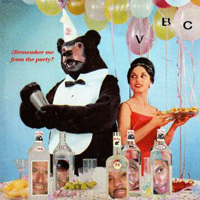
VERY BE CAREFUL
REMEMBER ME FROM THE PARTY?
I was wondering how much accordion-driven Vallenata I needed in my collection, especially since I already have the previous excellent album Escape Room (2010) by Very Be Careful, but then as I listened to this latest release from the LA-based outfit I recalled what infectious energy they have. The band smokes along on traditional instruments, and for all I know this could have been recorded 50 years ago, but sounds fresh and alive today. They've been together for ten years and have a wide range of influences, from obvious ones, like Buena Vista Social Club, Antibalas and Carlos Vives to Joe Strummer & Gogol Bordello. Definitely one to keep close to the CD player.
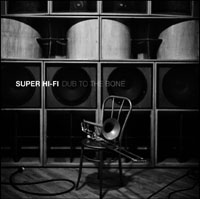
SUPER HI-FI
DUB TO THE BONE (Electric Cowbell)
This is a great concept, well executed. A dub album featuring two trombones as lead instruments. Fans of Jamaican music know Don Drummond's work and wish there were more of it. Here is a great continuation, not really a tribute to the Don, but a set of new music with dubs in a classic style, reminiscent of King Tubby. The leader of the group is the bassist, Ezra Gale, which bodes well for a good dub album. Right out of the gate they have a crumbling rumbling thuddy thing going on, with "Washingtonian." The double bone effect works well with the Roland Space Echo and the contrapuntal melody they send forth returning on delay and decay. There's minimal guitar with Echoplex. Returning to the old technology is always a wise move (though they have yet to put out a 78). The second cut "Tri tro tro" has been dematerialized by Beverley Road All Stars. It changes course midway through and an Ernie Ranglin-like guitar starts off in a new direction. It continues is a more mellow tone with the occasional lowering clouds of bone blowing ominous masses of brassy breath over the beach (like in "We will begin again" Trainwreck remix). Though it's a CD we then get to "Side two" which carries on in the same mode. It's short but made a nice lead-in to Ernie Ranglin's Below the Bassline, which it called to mind.
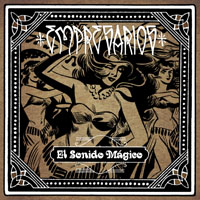
EMPRESARIOS
EL SONIDO MAGICO (Fort Knox)
Their first album promised a lot and this is a step forward for these American Latinos. They put out an EP earlier this year, i may even have put up a link to it, but as i get older i forget everything (which is why i write stuff down). It's "the Tropical Sounds of Washington, D.C.," which really sounds like an oxymoron, but the groove gives the lie to that notion. The bass is hyped up, the beats are complex, and the lyrics not too obnoxious. Retro-sounding synth washes over it all for a dancefloor-friendly vibe. "Volume" tells you to turn it up, and has a Kool & the Gang earnestness to it. It's more generic party music than sonic revelation, but sometimes that's good, no? After a foray into reggaeton -- "Rompan fila" -- they get tropical for "7th Street Groove" with horns escaped from a Michael Jackson session. The line-up seems to be a guitar and bass guy, a keyboard guy and a percussionist with two singers and guest trumpeters. Variety and revolving guests lift it out the regional drum 'n' bass category. The closer "Rey de reyes" with leader Paul Chaconas doing double-duty on bass and Melodica is their best shot at reggae, but the lyrics fail to engage. They keep it lively, but it seems like the Colombians are streets ahead for DJ music. I am not suggesting the Washingtonians self-deport to explore their roots, but there are big changes afoot in Latin music.